
The Camino: Redirecting Routes

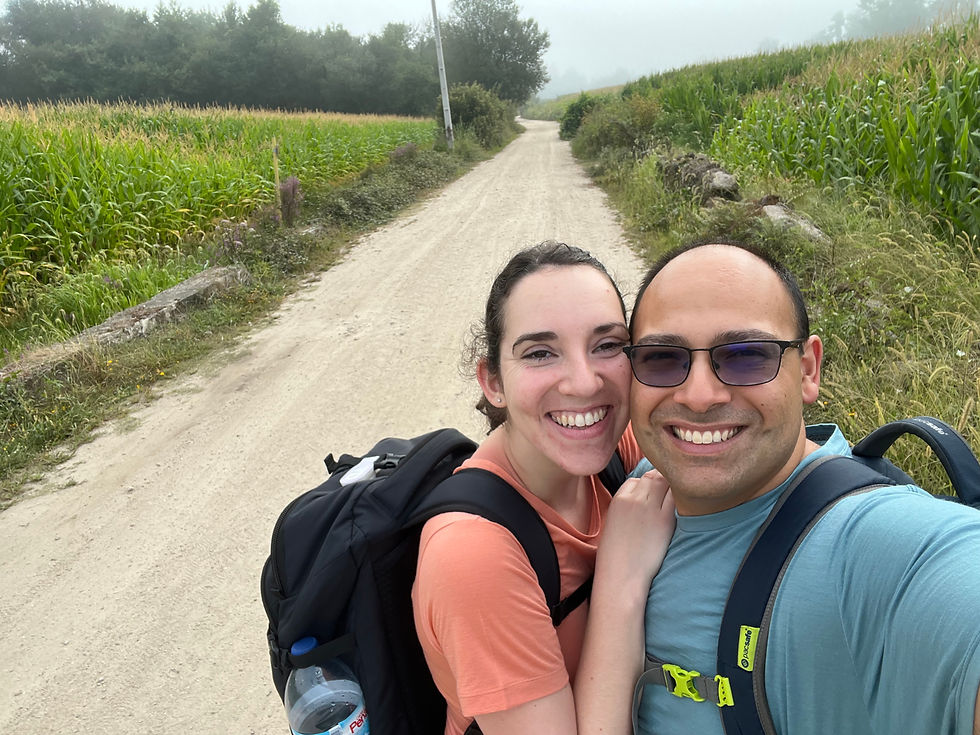
Elyse & Juan Maldonado on their honeymoon.
Walking the Camino de Santiago (Way of St. James) pilgrimage is perhaps an unconventional choice for a honeymoon. But so often, the Lord invites us into experiences that stretch us beyond the familiar or what others perceive as “normal.” He calls us to “not be conformed to this world” (Rom. 12:2).
When my husband, Juan, and I were deciding where to go for our honeymoon, we both agreed it should be a place that offered a completely new experience for us. We wanted somewhere that would give us a shared memory uniquely ours, a place of mutual discovery. Both of us had, separately, felt drawn to walking the Camino. A close friend of mine knew a colleague who completed the Camino a few years ago, and her experience first sparked my interest: I remember being struck by the simplicity of the journey. I wanted to experience that simplicity myself, especially when, as a society, we are often surrounded by distractions and commitments.
When Juan and I settled on the Camino, we felt at peace—it was where we sensed God calling us. We believed He was inviting us to begin our marriage in a way that would require unique sacrifice and would challenge us as a newly married couple.
Juan took the lead on research and planning for the honeymoon while I focused on other necessary, though less exciting, wedding details. We decided to walk the Portuguese Central Route, starting in Porto, over the course of 10 days. There are many helpful online guides for planning a Camino pilgrimage, and we planned to follow the recommended “stages” designed to guide walkers into pilgrim-friendly towns and keep each day’s mileage at a reasonable length.
As someone who finds comfort in structure and in knowing what the next day will hold, having a general itinerary set was reassuring. But I soon discovered that God’s invitation for us to walk the Camino on our honeymoon wasn’t simply an invitation to face a challenge together at the outset of our marriage; it was to be a lesson in discipleship, learning to let go of the plans we thought we had and follow after the Lord along unexpected paths. By the end of our first day on the Camino, the Lord had already rerouted us.
That first day included about 15 miles of walking. Our destination was an old monastery in Vairão that now houses a pilgrims’ hostel. With tired legs, we reached the entrance of the former monastery, a towering building nearly 1,000 years old and run entirely by volunteers. Full of character and history, it was a special place to spend the first night of our long journey. But it wasn’t the building itself that impacted us the most; it was the people we met there.
After being shown to our room, we dropped our backpacks on the floor, prayed together, and took a well-deserved shower. Soon after, we eagerly joined the communal evening dinner that our hostel offered to travelers. In the building’s simple yet elegant dining room—adorned by intricate blue wallpaper and antique cabinets, and almost entirely filled by a long wooden table surrounded by tall chairs that looked as if they belonged to an estate sale—about eight of us sat down for dinner, including two of the monastery’s volunteers. Among the group was a Brazilian priest, a pair of young Italian men, a Portuguese fireman, and us, the honeymooners, only three days married. Though we all spoke different languages, our shared meal was nothing short of warmly hospitable. The priest from Brazil led grace before we all sat down to eat.
Sitting in that dining room, surrounded by people from different nations and languages, I couldn’t help but feel that God had carefully arranged this particular gathering.
During dinner, we discovered that all of us were on our very first Camino pilgrimage. But one of the volunteers, a middle-aged man, had walked many Caminos. He was already planning his next one—a pilgrimage to Rome that would take him months to complete. As an avid pilgrim, he shared that one of his all-time favorite routes on the Camino was the Spiritual Variant. “It is breathtakingly beautiful,” he said, before describing how serene the route is, particularly the Ruta da Pedra e da Auga (“Stone and Water Route”), a path through lush forest alongside flowing water.
The Spiritual Variant is a detour along the Central Route that begins in Pontevedra, deviating from the traditional path to include a scenic coastal and river journey to Padrón. The detour follows the route the remains of Saint James are said to have taken by sea from Jerusalem. Juan and I had been interested in taking this detour when we planned our trip; however, we decided not to, since we didn’t feel we had time for the extra day of walking it would require. As we sat at dinner that night, however, God began working through the experienced pilgrim to convince us otherwise.
The more he spoke, the more I sensed an interior nudge telling me that this wasn’t just casual advice. It felt like one of those quiet moments when the Holy Spirit slips an invitation through someone else’s voice. We had gone into the trip believing our schedule was fixed, but God used this stranger to open a door we had already closed. It was a reminder to me of the importance of maintaining a spiritual posture of openness and attentiveness: God’s will is rarely shouted; it is often whispered through encounters we might overlook.
As we said our goodnights after dinner, Juan and I climbed the stairs up to our room. We had both perceived God’s voice in this encounter, and knew we had to make the Spiritual Variant happen or we might regret it.
Both Juan and I lead busy lives with many commitments on a regular basis, and are planners by nature and necessity, and I recognized that in this redirection, God wasn’t asking us to stop planning; He was teaching us to hold our plans loosely. In choosing to follow his redirection, we were learning discipleship—surrendering our plans so He could unfold his. It felt like a living out of Proverbs 16:9, which says, “The human heart plans the way, but the Lord directs the steps.” When I read this verse, I’m reminded that even when we believe our plans are fixed, God can adjust and sometimes overturn them to lead us toward something better. He guides each step with a purpose we often only understand in hindsight.
To make the Spiritual Variant work within our time frame, we knew we would have to push ourselves beyond what the guides typically recommend: It would add roughly 30 additional miles to our journey, which meant harder days, longer climbs, and sore feet. But the Lord was asking for us to go the extra mile with Him. We wouldn’t be alone.
Embracing this deeper surrender taught me about discipleship in a way that carries beyond the Camino, into daily life. Through this experience, I learned that holding one’s plans too tightly—trying to be in control—is a symptom of trusting too much in ourselves, and not enough in God. And letting go is worth it: The extra miles became a place of encounter where we experienced God strengthening what was weak and expanding what we believed was limited. With every step past our comfort and expectations, our strength faded and our need became undeniable. We noticed how God provided us with constant endurance for our tired bodies. When we were hungry, a cafe was just around the corner. When we were tired, a bench swing revealed itself tucked between trees. When we lost our direction, a yellow arrow pointed us to the right way. There is a saying that “the Camino provides,” acknowledging that essential needs like food, shelter, and rest appear when required. Indeed, the Lord provided at every crossroad.
By submitting to his will, we weren’t just altering our itinerary; we were allowing God to teach us that his plans, even when demanding, lead to something better.
The pilgrim hostel in Vairão, formerly a monastery, where the Maldonado's stayed.


Comments